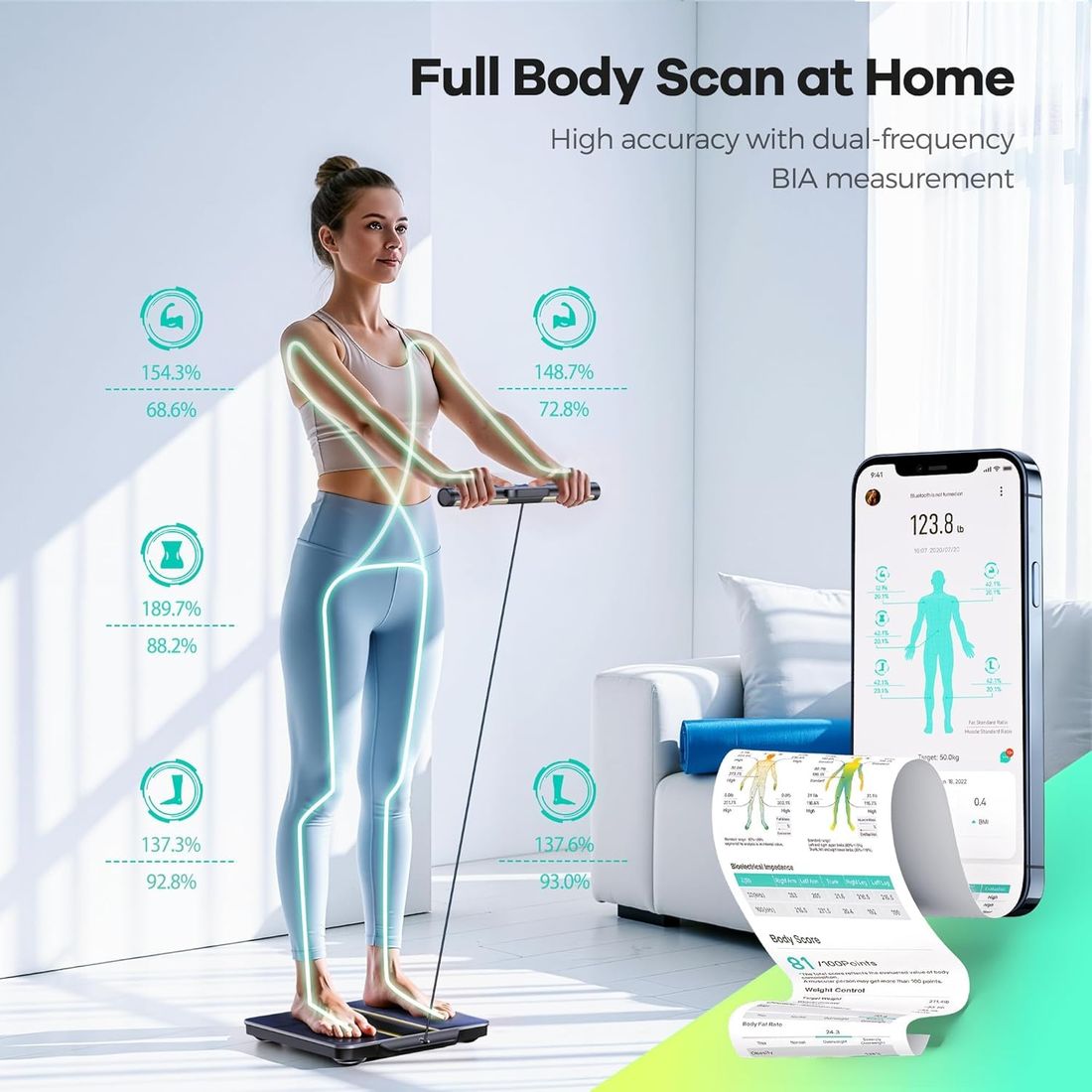
Step on almost any modern smart scale and, a few seconds later, you get far more than your weight: body fat percentage, muscle mass, body water and more. The technology behind those numbers is called bioelectrical impedance analysis, or BIA. Understanding how it works helps you get better results from your device — and read those results sensibly.
How BIA works
Your body conducts electricity, but not evenly. Muscle holds a lot of water and electrolytes, so it conducts well. Fat holds very little water, so it resists current. A BIA device sends a very small, painless alternating current between electrodes and measures the resistance (impedance) it meets.
Combine that impedance with your height, weight, age and sex, and validated equations estimate how much of your body is lean tissue versus fat.
4 electrodes vs 8 electrodes
A standard smart scale has four electrodes, all under your feet. Current enters one foot and leaves through the other, so it mainly travels through your legs and lower body. The scale then estimates your upper body.
An 8-electrode analyzer, like the ADAK Pro Body Composition Analyzer, adds four electrodes in a hand-held bar. Now the current can be measured through each arm, each leg and the trunk separately. That gives you:
- Segmental results — fat and muscle for left arm, right arm, trunk, left leg and right leg.
- Better whole-body estimates, because the upper body is measured rather than assumed.
- Balance insights — useful if you are recovering from an injury or training one side more than the other.
What about dual frequency?
Low-frequency current mostly flows around cells (through extracellular water), while higher frequencies pass through cell membranes too. Measuring at two frequencies helps the device separate those water compartments, which generally makes body composition estimates more stable.
How to get consistent readings
- Measure at the same time of day — first thing in the morning is ideal.
- Use the bathroom first, and measure before eating, drinking large amounts or exercising.
- Stand barefoot with clean, dry feet, and hold the handle electrodes fully.
- Put the scale on a hard, flat floor — not carpet.
- Look at weekly averages and trends rather than any single day.
Who should not use BIA?
People with a pacemaker or other implanted electronic medical device should not use BIA. During pregnancy, use weight-only mode — the ADAK analyzer has a dedicated pregnancy mode for this.