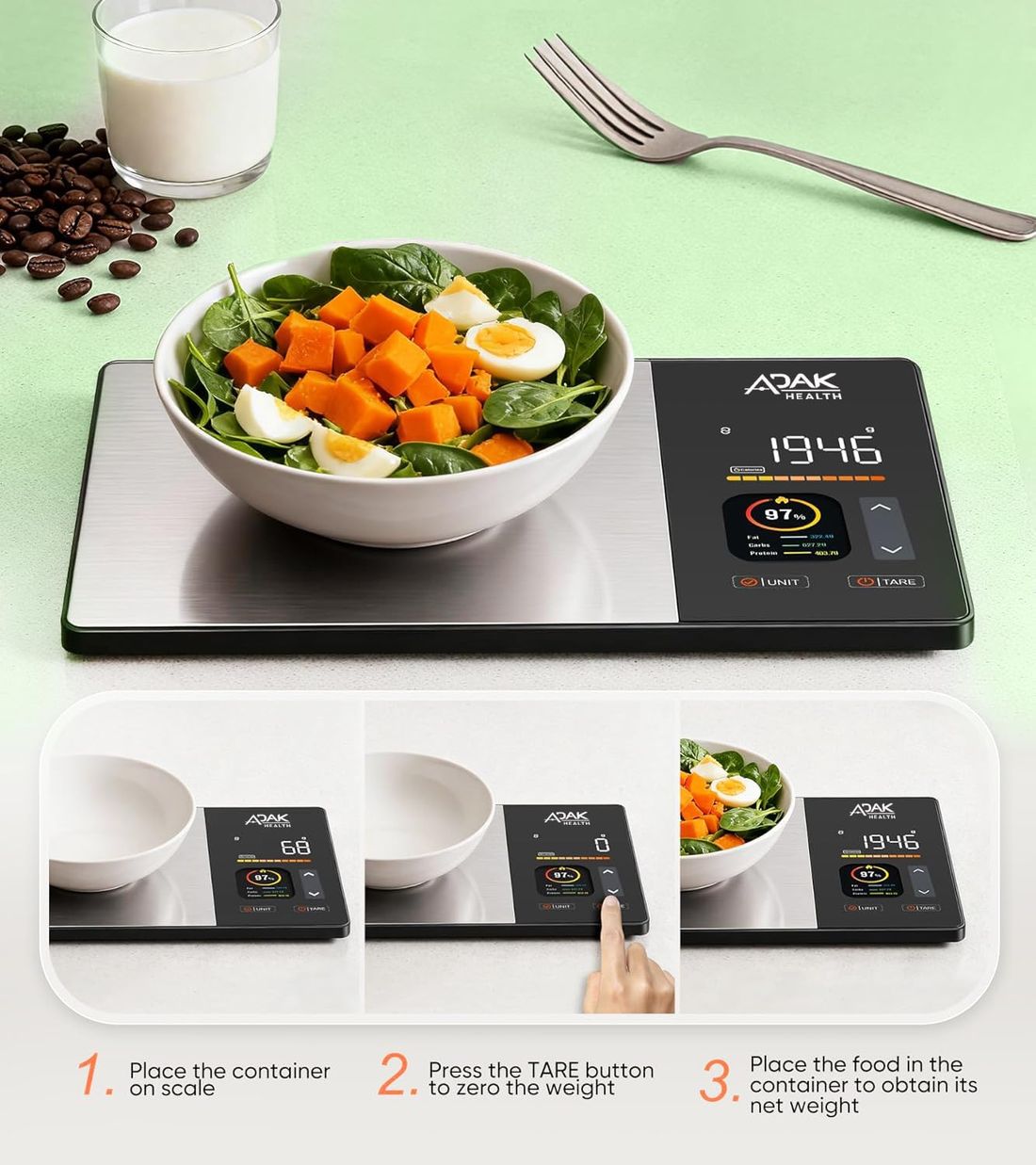
Most of us are not very good at estimating how much food is on our plate. A “handful” of nuts, a “bowl” of rice or a “drizzle” of olive oil can vary widely from day to day. Those small differences add up over a week — which is why people who track food often find that weighing it is a turning point.
Why weight beats volume
Cups and spoons measure volume, but foods pack differently. A cup of loosely filled oats weighs much less than a packed one. Grams do not change, so a kitchen scale gives you the same answer every time.
What a smart nutrition scale adds
A regular kitchen scale tells you the weight. A smart nutrition scale also tells you what that weight means:
- Calories, fat, carbs and protein for the exact portion, shown on the scale’s colour screen.
- Stored favourites — the ADAK scale holds 50 user-defined foods offline.
- Daily tracking — the app logs each item against your calorie and macro targets.
A simple 3-step routine
- Place your bowl or plate on the scale.
- Press TARE to zero it.
- Add each ingredient, select the food, and read the nutrition — tare again between ingredients.
Where it makes the biggest difference
Calorie-dense foods — oils, nut butters, nuts, cheese, rice and pasta — are where estimation errors are largest. Weighing just these few items often closes most of the gap between what you think you eat and what you actually eat.